
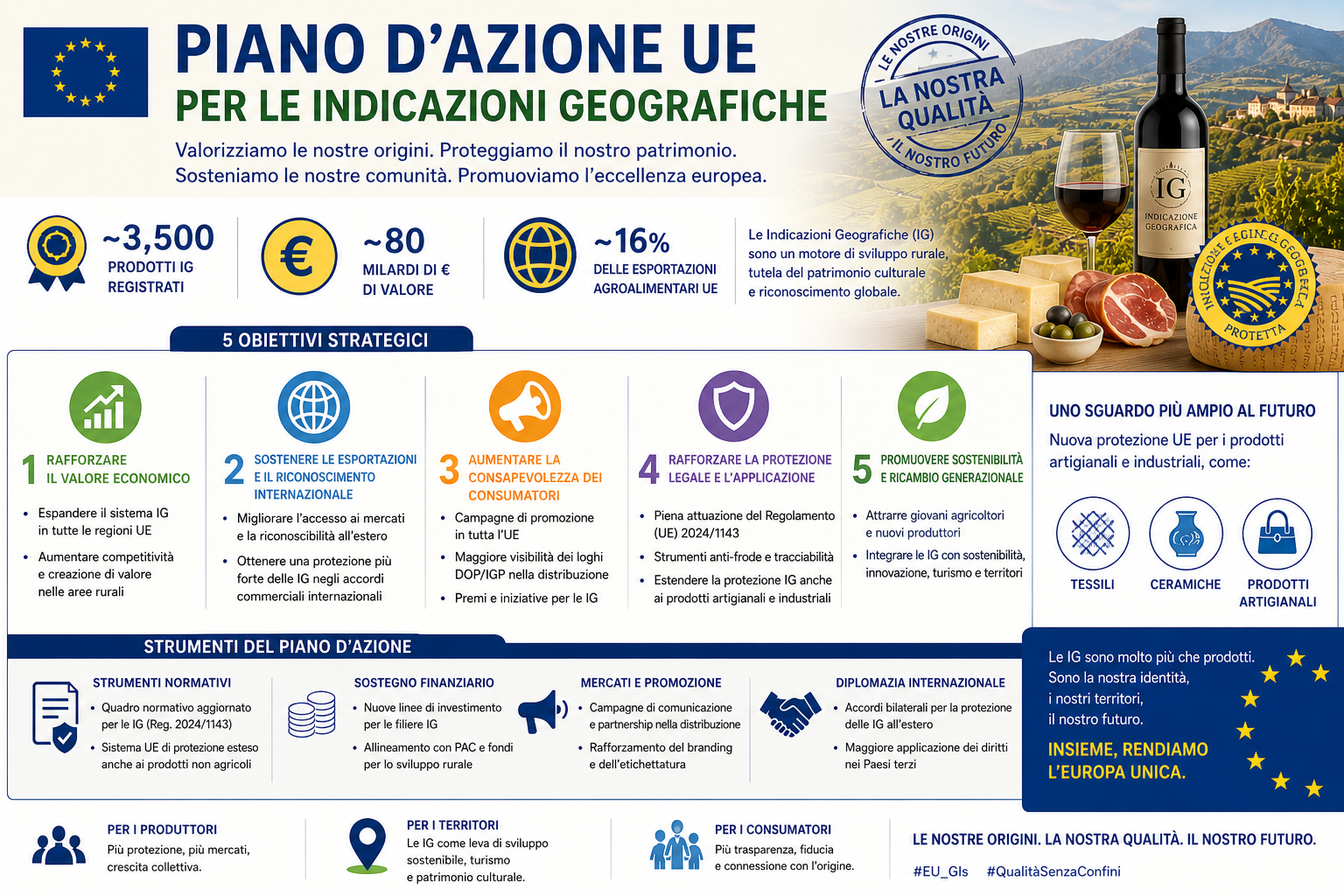
The new EU action plan for geographical indications in seven questions and answers
1. What are the main obstacles to the recognition of geographical indications in some Italian regions? (Regulatory? Awareness? Capacity?)
Regulatory and procedural obstacles
- Complexity and excessively long timeframes of the recognition process
- High costs of preparing the technical documentation and studies required
- Difficulty in interpreting the requirements of the product specification
- Lack of qualified technical and administrative support in less represented regions
Awareness obstacles
- Poor knowledge of the economic and competitive benefits of GIs among small producers
- Weak associative culture, which limits the ability to create truly operational and effective protection consortia
- The mistaken perception that GIs are tools reserved for large, established productions
- Growing distrust among producers towards consortia seen as bureaucratic, not transparent and far removed from the real economic needs of businesses
Capacity obstacles
- Lack of financial resources to support the recognition process
- Shortage of technical skills to draft product specifications and control plans
- Fragmented production that prevents reaching the necessary critical mass
- Limited ability of small businesses to invest in traceability and certification
- Structural weakness of protection consortia which, under the current legal and administrative set-up, lack adequate operational, tax and financial tools to perform territorial economic development functions
Structural issue
- The current legal form of protection consortia (mainly unrecognised associations or voluntary consortia) is inadequate and does not allow them to operate effectively as economic actors able to enhance the territory
2. What actions could help support the registration of geographical indications in Italy?
Simplification and institutional support
- Dedicated regional help desks providing technical assistance in preparing applications
- A national digital platform to guide the recognition process step by step
- Shorter procedures through a fast track for well-documented traditional products
Financial support
- Dedicated funds covering all or part of the costs of recognition (studies, analyses, consultancy)
- Tax incentives for businesses starting GI recognition processes
- Specific regional calls for traditional products at risk of disappearing
Training and capacity building
- Free training programmes for producers and technicians on product specifications, controls and consortium governance
- Mentoring networks between established consortia and new initiatives
- University and higher technical institute (ITS) courses specialising in GI management
Territorial awareness
- Targeted information campaigns on the economic success stories of GIs
- Highlighting the link between GIs, food and wine tourism and rural development
- Active involvement of Chambers of Commerce and trade organisations
Structural reform of protection consortia
a) Revision of the legal form:
Mandatory transformation of protection consortia into public-private bodies with recognised legal personality, on the model of Chambers of Commerce or territorial agencies, with:
- Managerial, financial and accounting autonomy
- The ability to act as fully-fledged economic actors
- Binding territorial representation powers
Alternatively, a new specific legal entity could be created – a “Geographical Economy Consortium” governed by national law, with hybrid features between a public body and a private company
b) Consistent administrative and tax rules
A dedicated tax regime recognising the public-interest function of consortia:
- VAT exemption for activities to protect, promote and enhance the territory
- Tax relief on investments in research, innovation and territorial development
- Full deductibility of consortium fees for member businesses
Transparent and certified accounts, with obligations to publish a social report and annual public reporting according to international standards (GRI, B-Corp)
Democratic and professional governance:
- Separation between strategic direction (members’ assembly) and operational management (professional management)
- Certified skills required for executive roles
- Incompatibility with elected political office
- Mandatory rotation of positions
- Mandatory representation of producers, processors and the territory
c) Stronger functions and powers
Territorial economic planning powers, including the ability to:
- Directly manage CAP, NRRP and other public funding instruments
- Enter into agreements with public bodies for territorial services
- Set up service companies for commercial activities (export, e-commerce, licensing)
- Issue legally valid quality and authenticity certifications
Investment capacity and capitalisation:
- The possibility of acquiring stakes in supply-chain businesses
- Creation of guarantee funds and financial instruments for producers
- Investment in territorial infrastructure (warehouses, logistics platforms, processing centres)
A central role in managing the supply chain:
- Collective bargaining with large retailers and distributors
- Centralised export management with international framework agreements
- Price discovery systems and binding market observatories
d) Accountability obligations
- Quarterly publication of financial statements and reports
- Economic, social and environmental impact assessment certified by third parties
- Satisfaction surveys among member producers
- Recall and revocation mechanisms for non-compliance
e) Transition and implementation:
- A five-year reform plan with technical and financial support from the State
- Voluntary trials with 10 pilot consortia (diversified by sector and size)
- Mandatory training for consortium directors and staff
- Continuous monitoring and regulatory adjustment
The current system of protection consortia, based on voluntary associative structures, no longer meets the challenges of a globalised economy. GIs represent an economic asset worth over €19 billion and a strategic territorial resource: they need professional governance, investment capacity, bargaining power and operational tools on a par with those of major institutions, while keeping their collective-interest purpose. Without this structural reform, any action to support GIs risks being ineffective.
3. What are the main obstacles to consumers’ awareness of geographical indication symbols in Italy?
Communication and visibility issues:
- Little visual difference between the PDO, PGI and TSG symbols, which causes confusion
- Limited and often barely visible presence of the symbols on packaging, relegated to secondary positions
- Insufficient and fragmented institutional communication on the meaning and values of GIs
- Competition with more aggressive and recognisable private claims and brands
- Lack of coordinated communication strategies at consortium level, due to a shortage of financial resources, marketing skills and a shared strategic vision
Educational issues:
- Lack of structured food education in schools on the system of certified quality
- Absence of clear and accessible information at points of sale
- Limited understanding of the difference between GIs and other certification systems (organic, fair trade, etc.)
Market issues:
- In the HoReCa sector (restaurants and catering), the symbols are almost entirely absent from menus and communications
- In online food retail, search filters for GIs are rare or ineffective
- Large retailers do not adequately highlight GIs in their merchandising strategies
- In their current configuration, consortia have neither the bargaining power nor the tools to impose communication standards on distributors
4. What actions could help improve awareness and visibility of geographical indications in Italy?
Integrated communication strategies:
- A permanent national multichannel campaign (TV, social media, out-of-home) on the values of GIs: quality, territory, sustainability
- Narrative digital content (storytelling, video, podcasts) about producers and territories
- A national mobile app to locate and discover GIs, with integrated e-commerce
Retail and HoReCa measures:
- Mandatory clear indication of GIs on public and private catering menus
- Agreements with large retailers for dedicated GI areas with information materials
- Certified training for restaurateurs, buyers and sommeliers on Italian GIs
- Dynamic QR codes on labels linking to multimedia content about the product and the territory
Education and training:
- Structural inclusion of GI education in school curricula (primary and secondary)
- Educational projects with visits to producers and sensory workshops
- Training courses on the GI system for journalists, food bloggers and influencers
- Free masterclasses and guided tastings in production areas
Digital innovation:
- Immersive experiences linked to the product and the territory
- Certified e-commerce platforms with a guarantee of authenticity
A new role for protection consortia:
a) Integrated territorial marketing
Reformed consortia as destination marketing agencies able to:
- Manage significant advertising budgets (3–5% of production value)
- Coordinate omnichannel strategies that can be integrated with regional tourism bodies
b) Bargaining power in distribution
The ability of consortia to negotiate national framework contracts with:
- Large retailers: display standards, materials, staff training
- E-commerce platforms: dedicated certified sections
c) Investment in communication infrastructure
Consortium digital hubs with:
- Integrated CRM for a direct relationship with end consumers
- Data collection and analysis systems for evidence-based strategies
d) Educational programmes at scale:
Consortia as accredited training providers for:
- Hotel schools and agricultural institutes (structural partnerships)
- Mandatory continuing training for GI-certified operators
- Professional certifications (GI tasters, territorial ambassadors)
5. What are the obstacles to including geographical indications in public procurement procedures in Italy?
Regulatory and interpretative obstacles:
- Restrictive interpretation of the principles of non-discrimination and free competition in public procurement
- Contracting authorities’ fear of legal challenges for alleged breach of EU rules
- Lack of clear and binding national guidelines on the use of GIs in the Minimum Environmental Criteria (CAM)
- Difficulty in drafting tender specifications that reward GIs without breaching procurement rules
Skills obstacles:
- Poor training of contracting authority staff on the possibilities offered by current legislation
- Lack of technical skills to properly assess the quality characteristics of GIs
- Lack of specialised technical support in drafting calls for tender
Economic and logistical obstacles:
- The (often mistaken) perception that GI products cost more than budgets allow
- Difficulty in planning supplies of large, continuous quantities
- Fragmentation of GI production, which complicates supply logistics
- Insufficient platforms for aggregating the GI supply
Cultural obstacles:
- Prevalence of lowest-price logic over quality and sustainability criteria
- Lack of awareness of the territorial, environmental and social added value of GIs
- Lack of political will to adopt good practices
6. Which strategies and/or good practices already in place in Italy at national or regional level are considered effective for including geographical indications in public procurement?
Regional good practices:
- Tuscany: a regional law encouraging the use of zero-km and PDO/PGI products in school and hospital canteens, with financial rewards for bodies that reach certain percentages
- Emilia-Romagna: the “Food and health” protocol, which promotes GIs in collective catering through standardised model specifications
- Veneto: a system for aggregating supply through regional purchasing centres dedicated to GI products
- Lombardy: pilot projects promoting GIs at the Milan–Cortina 2026 Winter Olympics as a replicable model
Municipal good practices:
- Municipality of Parma: school canteen specifications requiring the use of at least 3 local PDO/PGI products
- Municipality of Siena: award criteria for GIs in catering tenders for public events
- Municipality of Bologna: mandatory training for suppliers on the characteristics of local GI products
Effective tools:
- Model specifications and operational guidelines developed by ANAC (the Italian Anti-Corruption Authority) and the Ministry in collaboration with consortia
- Use of “improving variants” to reward offers of GI products
- The most economically advantageous tender (MEAT) criterion with a strong weighting for certified quality
- Regional lists of certified GI suppliers to simplify tender procedures
- Specific, continuous training for public procurement officers
Innovations to replicate:
- Regional digital platforms connecting GI producers and contracting authorities
- Digital monitoring and certification systems for GI supplies
- Memoranda of understanding between Regions, protection consortia and central purchasing bodies
A new role for protection consortia:
a) Consortia as eligible participants in tenders:
With a new legal form, consortia could:
- Be recognised as “bodies governed by public law” under the Public Procurement Code, entitled to take part in tenders directly or as partners
- Operate as specialised central purchasing bodies to aggregate demand and supply of GI products
- Issue binding technical certifications in the verification and validation of supplies
b) Integrated management of the public supply chain:
- Consortia as managers of public e-procurement platforms dedicated to GIs
- Multi-year framework agreements with Consip (the national central purchasing body), regional purchasing bodies, local health authorities and universities
- Continuity and traceability guaranteed through certified consortium information systems
c) Institutional advisory and capacity building:
Consortia as technical support bodies for contracting authorities:
- Assisted drafting of technical specifications
- Certified training for procurement officers and tender committees
- Compliance checks during contract execution
d) Tax levers and incentives:
- Tax relief for public bodies that reach minimum shares of GI supplies certified by consortia
- Rewards in State and regional transfers for virtuous municipalities
- Revolving funds managed by consortia to help public administrations switch to GIs
e) Innovative contract models:
- Public-private partnerships with consortia to manage collective catering services
- Territorial concessions to consortia to turn public canteens into showcases for local GIs
- Project financing for investments in territorial processing and logistics infrastructure
7. Which Common Agricultural Policy (CAP) instruments are currently used to support geographical indications in Italy? Please give examples of effective approaches that could be shared.
Instruments currently used under the 2023–2027 Rural Development Complement (CSR):
Rural development interventions (EAFRD):
- SRD03 – Investments in farms for diversification into non-agricultural activities: support for farmers who diversify by enhancing GI products through agritourism, educational farms and direct sales
- SRD13 – Investments in the processing and marketing of agricultural products: tangible and intangible investments to improve processing, packaging and marketing of GI products (plants, technologies, certifications)
- SRE01 – Setting up of young farmers: a grant to encourage generational renewal in GI-producing farms, with extra points for those joining protection consortia
- SRE03 – Start-ups of new non-agricultural businesses in rural areas: support for new businesses that enhance GI products through innovation (specialised e-commerce, food-tech, sustainable packaging)
- SRH01 – Advisory services: specialist advice for GI businesses on sustainability, innovation, market access and certification
- SRH02 – Training of advisers: training advisers specialised in GI supply-chain management, sustainability and territorial marketing
- SRH03 – Training of farmers and others: courses for GI producers on production techniques, regulations, traceability and export
- SRD01 – Productive investments for farm competitiveness: modernisation of facilities and technologies for GI-producing farms (precision irrigation, renewable energy, digitalisation)
- SRD02 – Productive investments for environment, climate and animal welfare: green investments in GI farms to reduce environmental impact and improve animal welfare in line with product specifications
- SRD06 – Investments to prevent damage from harmful organisms and natural disasters: protection of GI production from plant health and climate risks (hail nets, frost-protection systems, integrated pest management)
- SRG01 – Support for EIP-AGRI operational groups: innovative European Innovation Partnership projects focused on GI supply chains (blockchain, precision farming, circular economy)
- SRG02 – Support for pilot projects and the development of new products/technologies: testing innovations applicable to GI production (resilient varieties, low-carbon processes, biodegradable packaging)
- SRG10 – Support for information and promotion initiatives by producer groups on EU quality schemes and national and regional quality systems, to improve business profitability and position in the value chain, consolidate quality food supply chains and increase consumer awareness and consumption of quality products on the EU internal market.
Sectoral CMO interventions:
Wine sector (Reg. (EU) 1308/2013, Arts. 40–54 > Regulation (EU) 2026/471):
- Promotion of PDO and PGI wines on non-EU markets
- Vineyard restructuring and conversion
- Investments in wineries for quality wines
- Technological innovation for certified wines
Olive oil sector:
- Quality improvement of PDO/PGI olive oil production
- Traceability and certification
Fruit and vegetable sector (Producer Organisations):
- Operational programmes with specific actions to enhance GIs
- Promotion and communication of certified products
First pillar – eco-schemes (EAGF):
- ECO1 – Payment for reducing antimicrobial resistance and improving animal welfare: applicable to GI livestock products (PDO cheeses, PDO cured meats) that adopt good practices already required by their specifications
- ECO2 – Green cover in tree crops: support for PDO/PGI olive groves and vineyards with sustainable practices
- ECO3 – Safeguarding olive trees of special landscape value: protection of historic olive groves in PDO production areas
- ECO4 – Extensive forage systems with crop rotation: for GI livestock products linked to the territory (meat, cheese)
- ECO5 – Specific measures for pollinators: in GI production areas to promote biodiversity and ecosystem services
Examples of effective approaches:
Veneto Region – Integrating GIs and sustainability (SRD02 + eco-schemes):
- SRD02 calls awarding extra points to GI farms that adopt precision farming and reduce chemical inputs, combined with simplified access to eco-schemes
- “Sustainable GI districts” with integrated investments through SRD01, SRD02 and SRD06 in efficient irrigation, renewable energy and biodiversity
- Results: more GI farms certified organic within 3 years, lower use of plant protection products
Emilia-Romagna Region – Supply-chain innovation (SRG01 + SRD13):
- EIP-AGRI operational groups (SRG01) dedicated to GI supply chains, developing innovative solutions then implemented through SRD13 (processing investments)
- Integrated blockchain traceability projects for Parmigiano Reggiano PDO and Prosciutto di Parma PDO funded by SRG01 + SRD13
- Results: higher production value, better penetration of foreign markets, less supply-chain waste
Tuscany Region – Diversification and multifunctionality (SRD03 + SRE01):
- Integrated support for young farmers (SRE01) setting up in GI farms, with immediate options to diversify (SRD03) into agritourism and educational farms that promote Chianti DOCG, Pecorino Toscano PDO and Toscano PGI olive oil
- “Wine and flavour routes” with CSR investments coordinated with regional tourism funds
- Results: growth of food and wine tourism in GI areas, longer average stays, higher average spending
Sicily Region – Young people and generational renewal (SRE01 + SRH03):
- An integrated package: young farmer set-up (SRE01) with extra points for joining GI supply chains, plus mandatory specialist training (SRH03) on product specifications, sustainability and marketing
- Combined with SRD01 for the first farm investment
- Results: new young farmers in GI-producing farms, average age of GI entrepreneurs down to 41 (from 52)
Piedmont Region – Specialist advice (SRH01 + SRD13):
- An integrated system of specialist advice (SRH01) for GI businesses and consortia on access to international markets, followed by targeted investments (SRD13) in export-oriented facilities
- Focus on Barolo DOCG, Gorgonzola PDO and Nocciola Piemonte PGI
- Results: more direct exports by GI producers, new non-EU markets opened, higher average export value per business
Lombardy Region – Technological innovation (SRG02 + SRD01):
- Pilot projects (SRG02) on climate adaptation for Grana Padano PDO and Bresaola della Valtellina PGI
- Follow-up investments (SRD01) in barn climate control, cooling for ageing rooms and environmental monitoring
- Results: GI production maintained, lower energy costs, better certified animal welfare
a) Consortia as delegated paying agencies:
With a new legal and administrative configuration, consortia could:
- Be recognised as second-level paying agencies for the direct management of GI-specific CSR interventions
- Manage dedicated allocations for interventions SRD13, SRG01 and SRH01, reporting directly to AGEA/EU
- Speed up payments by cutting bureaucratic steps, with advances of up to 80%
b) Dedicated “GI-specific” CSR interventions:
New intervention SRD15 – “Investments in GI consortium infrastructure”:
- Budget: €200 million (2024–2027)
- Aid intensity: 70% of eligible expenditure
- Beneficiaries: reformed consortia with certified governance
- Scope: digital platforms, shared processing centres, logistics hubs, quality laboratories
New intervention SRE05 – “Establishing and strengthening GI consortia”:
- One-off grant of €50,000–150,000 for new consortia
- Structural support of €30,000/year for 5 years for consortia in under-represented areas
- Conditional on transparent governance, certified accounts and gender balance
Strengthening SRH01 with a dedicated line for “Strategic consultancy for consortia”:
- €500/day for a specialist consultant (vs. €350 ordinarily)
- Topics: internationalisation, innovative finance, blockchain, certified sustainability
- Ceiling of €100,000 per consortium (vs. €50,000 for individual businesses)
c) GI-specific eco-schemes
New ECO6 – “Sustainable practices in GI production”:
- Automatic recognition of the environmental value of certified GI product specifications
- Payment: €180–250/ha (GI tree crops), €120–180/ha (GI arable crops), €100/LU (GI livestock)
- Condition: third-party certification of the environmental impact of the product specification
- Estimated beneficiaries: 45,000 GI farms
- Indicative budget: €250 million/year
d) Integrated territorial projects (PIT) led by consortia
Reformed consortia as mandatory lead partners of multi-intervention projects combining:
- SRD01 + SRD02: investments by member producers (60% of the PIT budget)
- SRD15: shared consortium infrastructure (20%)
- SRG01 + SRH03: innovation and training (10%)
- SRD03: diversification and territorial multifunctionality (10%)
Dedicated PIT budgets: €5–20 million per GI territory with certified consortium governance
Priority: GIs in inland and mountain areas at risk of abandonment
Trial 2025–2027: 15 pilot PITs (3 per Italian macro-area)
e) Innovative financial instruments (Art. 59 of Reg. (EU) 2021/2115):
EAFRD consortium guarantee fund:
- Initial allocation: €150 million EAFRD + private co-financing
- Leverage 1:4 (mobilising €600 million in credit)
- Management: reformed consortia in partnership with the banking system
- Purpose: easier access to credit for GI producers for SRD01, SRD02 and SRD13 investments
- Subsidised rates: Euribor +0.5% (vs. +2.5–3% on the market)
Revolving fund for GI territorial investments:
- €100 million EAFRD revolving over twenty years
- Subsidised loans to consortia for shared infrastructure (SRD15)
- Repayment over 15 years, 0.5% rate, 3-year grace period
f) Stronger conditionality and rewards:
Priority access to SRD/SRE/SRG interventions conditional on:
- Membership of reformed consortia with certified transparent governance (+20 points)
- Compliance with certified environmental, social and economic consortium standards (+15 points)
- Participation in consortium traceability and quality systems (+10 points)
Higher aid intensity:
- +10% for farms belonging to certified consortia
- +15% if the consortium is in a mountain or inland area
- +20% for young farmers setting up in a GI farm that is a consortium member
g) Integration with other EU funds:
Reformed consortia as direct ERDF beneficiaries for:
- Digital infrastructure (blockchain, territorial e-commerce platforms): €80 million
- Renewable energy investments in GI supply chains (biodigesters, photovoltaics, geothermal): €120 million
- Territorial research and innovation centres in partnership with universities/ITS: €60 million
CSR–EMFAF synergies for fishery and aquaculture GIs:
- Investments in processing GI fishery products
- Diversification of fishers and fish farmers into GI-related activities
Synergies with Horizon Europe – consortia as partners in R&I projects on:
- Climate adaptation of GI production (resilient varieties, conservation techniques)
- Circular economy in supply chains (use of by-products, biodegradable packaging)
- Advanced traceability and authentication (DNA barcoding, stable isotopes, blockchain)
- Indicative budget: €40 million (50% EU co-financing)
h) Monitoring, evaluation and accountability
Impact reporting obligations for consortia managing CSR funds. Economic indicators (baseline + annual change):
- Value of certified GI production
- Value added per annual work unit (AWU)
- Average net income of member producers
- Employment (total AWUs, young people <40, women)
- Exports (value, markets, share of turnover)
Environmental indicators (compliance with specifications + improvements):
- Carbon footprint per kg of product (scopes 1–2–3)
- Water footprint and irrigation efficiency
- Biodiversity (Shannon indices, indicator species)
- Use of plant protection products and fertilisers (kg/ha, organic/integrated UAA)
- Agroforestry areas and green infrastructure
Social indicators:
- Generational renewal (average age, new entrants <40)
- Presence in marginal areas (producers resident in inland/mountain areas)
- Gender balance (% women in governance, women entrepreneurs)
- Training (hours/year per worker)
- Certified animal welfare (% of certified farms)
Territorial indicators:
- Food and wine tourism (arrivals, overnight stays, average spending)
- Land stewardship (GI UAA as share of total UAA, abandonment)
- Shared infrastructure (number, use, efficiency)
Performance reward/penalty system:
- Rewards: +20% of the following year’s allocation if targets are exceeded by 15% or more
- Penalties: −15% of the allocation if targets are missed by more than 20%, suspension of fund management if by more than 30%
i) Institutional capacity building
Five-year training programme (CSR technical assistance – €25 million). For consortium directors and staff:
- Project management and EU fund reporting (120 hours/course)
- Innovative finance and financial instruments (80 hours)
- Territorial marketing and digital communication (100 hours)
- Sustainability and environmental certifications (60 hours)
- Target: 100% of consortium managers certified by 2027
For member producers:
- Precision agriculture and digitalisation (40 hours)
- Sustainable practices and climate-smart agriculture (60 hours)
- Export and international marketing (50 hours)
- GI regulations, food safety, traceability (30 hours)
- Target: 60% of producers trained by 2029
For local public bodies:
- Integrated project design and territorial partnerships (60 hours)
- Green public procurement (GPP) for GI products (40 hours)
- Experiential tourism and destination management (50 hours)
- Target: all municipalities in GI areas trained by 2028
l) Simplification and digitalisation
National CSR–GI digital platform:
- Automated calls with pre-filled data for GI businesses
- Simplified reporting based on certified standard costs by GI type
- Faster payments: 50% advance (vs. 35% ordinarily), balance within 60 days of validation (vs. 90 days)
- Real-time monitoring of project progress
- Investment: €8 million (CSR technical assistance)
- Estimated savings: −40% in assessment times, −30% in administrative costs
Concluding remarks on the questionnaire
The EU Action Plan for GIs will not achieve its ambitious goals without a thorough reform of the bodies responsible for implementing it on the ground: protection consortia. Italy, with 887 registered GIs and an economic value of over €19 billion, should lead this transformation at European level by proposing:
1_the explicit inclusion in the EU Action Plan of a section on “Reforming GI governance”, establishing:
- Minimum European standards for the legal forms of consortia
- Requirements for transparency, professionalism and accountability
- Minimum powers to perform territorial economic development functions
- Recognition of consortia as direct beneficiaries of CAP funds and other EU instruments
2_an Italian pilot as a European best practice, through:
- National legislative reform by 2027 (a framework law on Geographical Economy Consortia)
- 15 pilot projects under the 2023–2027 CSR with scientific monitoring (3 per macro-area + diversified sectors)
- Independent and certified impact evaluation
- Dissemination of results and replicable models to other Member States (workshops, publications, a knowledge-sharing platform)
3_making EU funds dedicated to GIs (post-2027 CAP, CMO, promotion funds, rural development programmes, financial instruments) conditional on governance structures meeting the new standards:
- An appropriate legal form with recognised legal personality
- Certified accounts and impact reporting
- Democratic and professional governance
- Minimum operational and financial capacity
Recognition of a new strategic role for protection consortia in post-2027 programming:
- Direct beneficiaries of dedicated structural interventions
- Intermediate bodies for managing territorial funds
- Preferred partners in PITs and multi-fund projects
- Certifying and guarantor bodies for public procurement and international trade
Only with consortia that are truly able to operate as strategic economic actors in their territory – equipped with adequate legal, administrative, tax and financial tools and fully integrated into the programming and implementation of the 2023–2027 CSR and beyond – can the enormous potential of Geographical Indications be fully realised, ensuring:
- Sustainable economic development of supply chains and territories
- Active stewardship of rural areas and action against depopulation
- International competitiveness through aggregation and scale
- Transparency and accountability towards producers, consumers and institutions
- Innovation and resilience in the face of climate and market change
- Enhancement of Europe’s cultural and gastronomic heritage
Reforming consortia is not an optional extra: it is the essential precondition for the success of the EU Action Plan on GIs.


