
PDOs and PGIs: the revolution of protection consortia has begun
A new season is opening for designations of origin, calling for a radical rethink of their organisational and financial set-up: institutional protection, service companies and territorial alliances can become the three pillars of change.
Ministerial Decree no. 264637 of 3 June 2026, implementing Regulation (EU) 2024/1143, significantly broadens the functions of protection consortia for agri-food PDOs and PGIs: in addition to protection, promotion and supervision, they now cover supply regulation, tourism linked to designations, sustainability, action against fraudulent uses including online, and multi-GI consortia.
For most consortia – small, under-capitalised and without a real organisation – the concrete risk is that the new framework will translate into additional obligations and expectations without matching tools, widening the gap with the larger consortia.
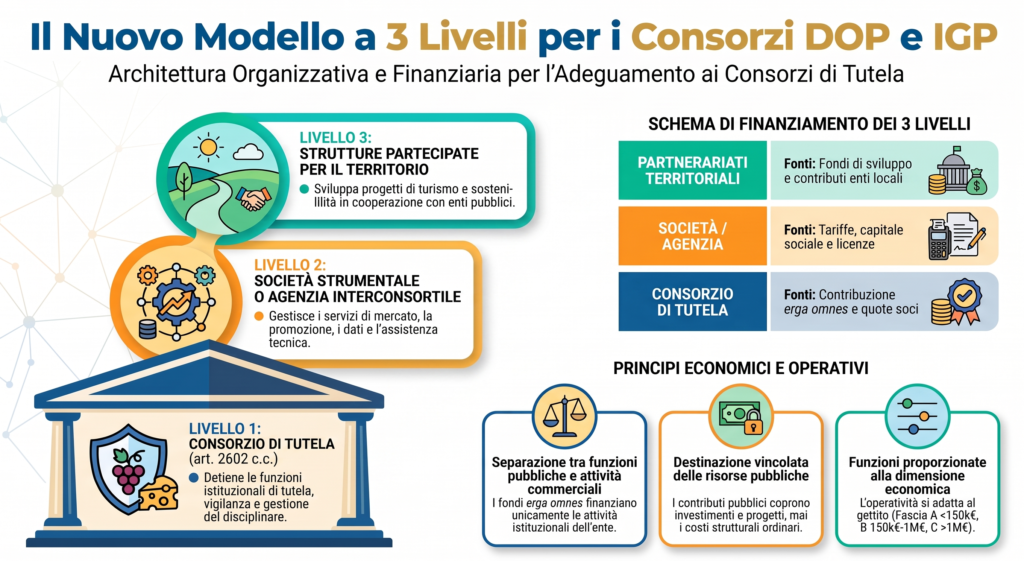
My proposal is a three-tier consortium model:
(1) the protection consortium under Art. 2602 of the Italian Civil Code remains responsible for the institutional functions funded by the erga omnes levy;
(2) a consortium service company (Art. 2615-ter of the Civil Code) – its own for large consortia, shared between consortia for small ones – carries out service and market activities with its own capital and accounts;
(3) territorial functions are exercised through structures shared with public bodies (agreements, food districts, participatory foundations) that give them legitimacy.
The model comes with a funding mix in which public resources cover investments and projects, not the ordinary structure, and with a matrix of functions differentiated across three size bands.
A_The context
The legal framework of consortia
Protection consortia are set up as consortia under Art. 2602 of the Civil Code and recognised by MASAF (the Italian Ministry of Agriculture) under Art. 14 of Law 526/1999 for agri-food products and Art. 41 of Law 238/2016 for wine. Only the consortium fund is liable for obligations entered into with third parties by a consortium with external activities (Art. 2615 of the Civil Code). The consortium does not aim to distribute profits. Institutional activities are funded mainly by the mandatory levy charged to all users of the designation, members and non-members alike (the so-called erga omnes levy).
Ministerial Decree 264637/2026 concerns agricultural and food products; these considerations apply to wine protection consortia by analogy, with the necessary adjustments explained below.
An inadequate legal form
The consortium fund, the only guarantee for third parties, is usually modest in smaller consortia, and the non-profit purpose rules out risk capital. The result is low creditworthiness, difficulty in co-financing reimbursement-based projects and advancing expenses, and an inability to attract investors. Activities with a margin (services, tourism, events, paid marketing) raise issues of tax classification and of accounting separation from erga omnes funds, and may expose the consortium to challenges from contributing non-members. The Art. 2602 form is a real constraint, but not the root cause of weakness. Large consortia operate effectively within the same legal framework: the decisive variable is scale (value of certified production, number of operators, levy revenue). Reforming the form alone, without tools for aggregation and capitalisation, would have limited effect.
Legitimacy and scope of territorial functions
A consortium is a private association of businesses whose bodies are, by law, dominated by producers. Giving it responsibility for landscapes, sustainability, tourism development and supply-chain data raises questions of representation and accountability towards people who are not part of it: residents, local authorities, other supply chains. Competent authorities already exist for water, soil and services (Regions, river basin authorities, land reclamation consortia, local authorities). A consortium has no regulatory powers and can bind producers only through the product specification or voluntary agreements. Even “economic residency” depends mainly on public policies (inland areas, LAGs, regional programming).
Aggregation: underestimated technical obstacles
The multi-GI consortium is the decree’s most promising innovation for small designations. This means solving several issues: separate accounts for each designation, criteria for sharing common costs, the risk of cross-subsidies between strong and weak designations, and voting systems consistent with the decision-making autonomy required by Art. 9. Without rules on these points, aggregation produces bigger consortia, but not stronger ones.
Representation: the 66% threshold
The minimum representation threshold is also a constraint: bodies made up mainly of farmers, often small and with short-term horizons, are not necessarily best placed to decide on investments in organisation and managerial skills. In many designations in southern Italy, the concentration of votes in second-tier cooperatives is a further factor.
B_The proposal: a three-tier consortium system
Five guiding principles
1. Separate institutional functions from market activities. The former stay with the consortium and are funded by the mandatory levy; the latter move to an entity with its own capital, risk and accounts.
2. Share the structure before growing in size. For small consortia, the realistic path is not for each to build a complete structure, but to buy services from a shared one.
3. Legitimise territorial functions through public participation. What concerns the territory beyond the supply chain is carried out with the competent bodies, not in their place.
4. Public resources for investments and projects, own resources for the structure. Ordinary costs must be covered by stable income; public funds finance development, not survival.
5. Functions proportionate to size. Not every consortium has to do everything; each must do the essential core well and access the rest jointly.
Legal architecture
Tier 1. The protection consortium (Art. 2602 of the Civil Code)
It remains the body recognised by MASAF and responsible for the functions laid down by law and by the decree: legal protection, supervision, management and amendment of the product specification, consumer information, supply regulation where the conditions are met, and strategic direction. It is funded by the levy and by membership fees from members and non-members (erga omnes). It does not directly carry out commercial activities with a margin. Keeping this form is not a conservative choice: it is required by the current legal framework and allows mandatory resources to be focused on the functions for which they are collected, reducing the risk of disputes.
Tier 2. The consortium service company (Art. 2615-ter of the Civil Code)
A consortium limited company, possibly with benefit-company status, majority-owned by the consortium (or consortia) and open, within statutory limits, to qualified partners: cooperatives and businesses in the supply chain, Chambers of Commerce, research institutes and other consortia. It carries out service and market activities: technical assistance and advice to operators, support for sustainability programmes and their reporting, management of collective marks and licences, collective promotion and commercial services, tourism services and events, design and management of funded projects, and management of supply-chain data.
Expected benefits: real share capital and creditworthiness; access to public credit guarantees; accounts and taxation separate from institutional ones; the ability to employ permanent staff across several revenue lines; and the entry of partners without altering the governance of the recognised consortium.
The company could take two forms:
• its own service company, for large consortia with sufficient critical mass;
• an inter-consortium service agency, owned by several consortia in an area or supply chain, for small and medium-sized consortia. It would provide shared services (secretariat and administration, supervisory agents, legal and anti-counterfeiting assistance, online monitoring, project design and reporting, communication, data management) for a fee, with separate accounts for each consortium. It is the gradual alternative to the multi-GI consortium: it pools the structure without merging the governance of the designations, overcoming the obstacle of giving up sovereignty. In Campania, for example, project-based cooperation between consortia is already a reality: the projects funded under the second call of measure SRG10 of the 2023–2027 Rural Development Complement, submitted by individual and associated consortia, involve 16 of Campania’s 25 recognised protection consortia, for eligible funding of about €4.4 million. An inter-consortium agency would make this stable, turning occasional collaboration into a permanent structure.
Tier 3. Shared structures for territorial functions
Tourism linked to the designation, initiatives to develop local territorial quality and coordination on the use of common resources are carried out through instruments that include the competent bodies: programme agreements and protocols with the Region, local authorities and LAGs; participation in food districts; and, for permanent initiatives, participatory foundations with public and private founding members. The consortium contributes the designation, its reputation and its supply-chain expertise, without taking on alone functions for which it has neither legitimacy nor powers.
The data function
Supply-chain data management should sit within the service company or inter-consortium agency, not the consortium, with written rules on ownership, purpose, access and sharing of benefits, antitrust safeguards for commercial data and a preliminary check on whether the Data Governance Act applies. For small consortia it is reasonable to limit activity to mapping the available data and using aggregate indicators, leaving advanced functions to a regional or national scale.
Funding model
The model separates sources by purpose. The guiding rule is that the ordinary structure of each tier is covered by stable income; public resources contribute to investments, start-up and projects.
| Tier | Sources | Notes and conditions |
| 1. Consortium | Erga omnes levy; membership fees; reimbursements for supervisory activities where provided; public grants for institutional protection and promotion. | Proposal: split the levy into a basic share (institutional functions) and a value-enhancement share, based on value and not only volume; earmarked use, reported to contributors. |
| 2. Service company / agency | Share capital; fees for services to consortia and operators; income from collective-mark licences, events, tourism and commercial services; fees for project design; bank credit with public guarantees. | Goal: cover fixed costs with recurring revenue within a multi-year plan. Any royalties for using the designation as an ingredient must be checked against Reg. 2024/1143 and national rules. |
| 3. Territorial structures | Grants from local authorities, the Region and Chambers of Commerce; local development funds; founding members’ contributions; income from tourism services. | The consortium takes a small stake and contributes expertise; economic risk is shared with public partners. |
| Cross-cutting: public funds | 2023–2027 Rural Development Complement (promotion of quality products SRG10; cooperation SRG07; training and advice); EU promotion programmes (Reg. 1144/2014); supply-chain and district contracts; ERDF and ESF+ funds for innovation, digital and skills; European research and cooperation programmes for data projects. | Use funds for investments, agency start-up, information systems and staff training. Avoid using them to cover recurring structural costs. |
Each consortium should adopt a three-year economic plan with an indicator of how much of its structural costs is covered by its own income (levies, fees, service revenue). Below a minimum threshold to be defined, joining the inter-consortium agency or becoming a multi-GI consortium becomes the recommended choice.
Functions differentiated by consortium size
The following matrix distinguishes three bands. The size parameters are indicative and should be calibrated on sector data; a composite criterion could combine value of certified production, number of operators and annual levy revenue.
| Function | Band A – Small (indicatively: annual levy revenue below €150,000) | Band B – Medium (indicatively: €150,000 – €1 million) | Band C – Large (indicatively: over €1 million) |
| Legal protection and management of the product specification | Direct (essential core), with legal support from the agency | Direct | Direct, with in-house legal office |
| Market supervision | Supervisory agents shared through the agency | Direct or shared | Direct |
| Online protection and anti-counterfeiting | Shared monitoring at agency level | Own monitoring, legal action through the agency | Direct, including cross-border |
| Information and promotion | Jointly (multi-consortium projects) | Own plan, with joint projects for foreign markets | Own multi-year plan, foreign markets |
| Supply regulation | Not recommended | To be assessed, with external technical and legal support | Yes, where the conditions are met |
| Sustainability | Adherence to common protocols defined at agency level | Own voluntary programme with essential indicators | Structured programme with verifiable reporting |
| GI-related tourism | Participation in existing territorial agreements | Own guidelines and agreements with local authorities | Guidelines, agreements, possible participation in foundations |
| Economic observatory and value distribution | Shared basic indicators | Supply-chain observatory with aggregate data | Structured observatory, possible value-sharing clauses in compliance with competition rules |
| Data and digitalisation | Mapping of available data | Supply-chain database with access rules | Data platform with formal governance |
| Service company | Member of the inter-consortium agency | Member of the agency or own company | Own company; possible lead role for smaller consortia |
| Recommended organisational form | Inter-consortium agency; consider multi-GI | Agency or own light structure | Own full structure |
The matrix answers two questions: which functions are essential for everyone (protection, supervision, management of the specification, information) and which are accessible only above a certain scale or jointly.
Proposed regulatory adjustments
The proposed measures require action by the legislator or by MASAF and are put forward as hypotheses for discussion with sector organisations.
1. Express recognition of the service company. A rule or ministerial clarification explicitly allowing protection consortia to take part in consortium companies and networks for service activities, with criteria for accounting separation and a ban on using erga omnes levies to cover losses from commercial activities.
2. Recognised inter-consortium agencies. A regime allowing operational functions (supervision, monitoring, secretariat) to be entrusted to shared structures, while each consortium keeps its institutional responsibility.
3. A minimum consortium fund proportionate to the value of production, and a three-year economic plan, as requirements for confirming recognition, instead of verifying representativeness alone.
4. A national skills development fund to start up inter-consortium agencies and train technical staff, with temporary and decreasing resources.
5. Consortium bodies: the option of independent directors with managerial skills or a director with defined powers, while respecting the 66% share reserved for producers.
6. Tax clarifications on the treatment of activities carried out by consortia and service companies, to remove uncertainties that currently discourage new services.
Extension to the wine sector
Ministerial Decree 264637/2026 does not apply to wine consortia, which remain governed by Art. 41 of Law 238/2016, whose new implementing decree is currently in the final approval stage. The proposed framework is nonetheless transferable: the Art. 2602 consortium form and the erga omnes levy are common to both sectors, and the fragmentation of smaller wine designations raises the same problems of scale. For wine, the specific features of the sector must be considered: promotion and investment measures funded under the CAP sectoral interventions for wine, the role of public information systems (vineyard register, electronic registers) in data management, and the weight of cooperative wineries in governance. A regional inter-consortium agency could serve agri-food and wine consortia in the same territory together, with separate accounts.
Indicative implementation path
| Phase | Activities |
| 1. Diagnosis | Review of the budgets, staff, services and data of each consortium in the area; classification into bands; check of statutes and of compatibility with the Decree and Law 238/2016. |
| 2. Design | Definition of the agency’s service catalogue, fees and three-year economic plan; choice of members; draft statutes and shareholders’ agreements; tax opinion. |
| 3. Start-up | Incorporation of the consortium company; launch with two or three services with certain demand (secretariat, shared supervision, project design); applications for start-up funding. |
| 4. Consolidation | Extension of services (online anti-counterfeiting, sustainability, economic observatory); territorial agreements for tourism; assessment of possible mergers into multi-GI consortia. |
Main risks
| Risk | Level | Mitigation |
| Consortia reluctant to hand over operational functions | High | Start with services with low identity content (administration, supervision); keep the governance of each designation. |
| Under-use of services and economic imbalance of the agency | Medium-high | Multi-year minimum purchase commitments by members; gradual start-up; public funding limited to start-up. |
| Disputes over the use of erga omnes levies | Medium | Strict accounting separation; market-value fees; reporting to contributors. |
| Antitrust issues in exchanging economic data | Medium | Aggregated and anonymised data, management by a third party, specialist advice in advance. |
| Dependence on funding calls | High | Rule that fixed costs are covered by own income; diversification of sources. |
| Uncertainty over interpretation of the new rules | Medium | Prior dialogue with MASAF and the Region; phased amendment of statutes. |
In conclusion
Decree 264637/2026 and the debate that followed rightly shift attention from protecting the name alone to governing the designation as a collective asset. But a reform that assigns new functions without acting on form, resources and scale risks being effective only for consortia that were already strong. For the others – the majority – the question is not whether to become “businesses” or “territorial institutions”, but how to acquire the minimum capacity to perform their essential task well and access the rest jointly.
The proposal set out here meets this need with three choices: separating institutional functions from market activities, sharing the structure between consortia before asking each one to grow, and exercising territorial functions together with the competent public bodies. Its value must be tested in the field, starting with a detailed diagnosis of the consortia in a given territory. Campania, where cooperation between consortia on promotion projects is already a reality, lends itself to a pilot.
Nicola Matarazzo
Studio Matarazzo | Project management consultant
nicolamatarazzo.it
Sources (in Italian)
• A. Mattiacci, “Dalle radici al futuro. Il ruolo evolutivo dei consorzi nella strategia agroalimentare italiana”, L’Eurispes, 25 September 2026. https://www.leurispes.it/ruolo-evolutivo-dei-consorzi-nella-strategia-agroalimentare-italiana/
• A. Giordano, “Oltre la tutela. I Consorzi come infrastrutture territoriali di valore e conoscenza”, L’Eurispes, 29 September 2026. https://www.leurispes.it/oltre-la-tutela-i-consorzi-come-infrastrutture-territoriali-di-valore-e-conoscenza/
• MASAF, Ministerial Decree 264637 of 3 June 2026, general provisions on the establishment and recognition of protection consortia for PDO and PGI agricultural and food products. https://www.masaf.gov.it/flex/cm/pages/ServeBLOB.php/L/IT/IDPagina/24673
• MASAF, press release “Lollobrigida: Rafforziamo i Consorzi di tutela, più sostegno a DOP e IGP”. https://www.masaf.gov.it/lollobrigida-rafforziamo-consorzi-tutela-dop-igp
• VenetoNews, “Consorzi di tutela DOP e IGP: pubblicato il decreto che rivoluziona le regole”, 15 June 2026 (representativeness thresholds, multi-GI, governance). https://www.venetonews.it/2026/06/consorzi-di-tutela-dop-e-igp-pubblicato-il-decreto-che-rivoluziona-le-regole/
• HorecaNews, “La nuova stagione dei Consorzi di tutela” (supply regulation, Art. 21; sustainability, Art. 22). https://horecanews.it/la-nuova-stagione-dei-consorzi-di-tutela-dalla-protezione-delle-denominazioni-alla-gestione-del-valore
• PSR Campania Comunica, “Csr Campania 23-27, Comitato di Monitoraggio regionale” (SRG10: 16 of Campania’s 25 consortia involved, €4.4 million). https://psrcampaniacomunica.it/news/primo-piano-2025/csr-campania-23-27-comitato-di-monitoraggio-regionale-digitalizzazione-e-strumenti-finanziari-in-primo-piano/
• Campania Region, 2023–2027 Rural Development Complement, measure SRG10 “Promotion of quality products”. https://agricoltura.regione.campania.it/comunicati/comunicato_01-07-24T.html
Legal references
• Italian Civil Code, Arts. 2602, 2612, 2615, 2615-ter.
• Law no. 526 of 21 December 1999, Art. 14; Law no. 238 of 12 December 2016, Art. 41.
• Reg. (EU) 2024/1143 on geographical indications; Reg. (EU) 1144/2014 on information provision and promotion measures for agricultural products.
• Reg. (EU) 2022/868 (Data Governance Act); Reg. (EU) 2023/2854 (Data Act).


