
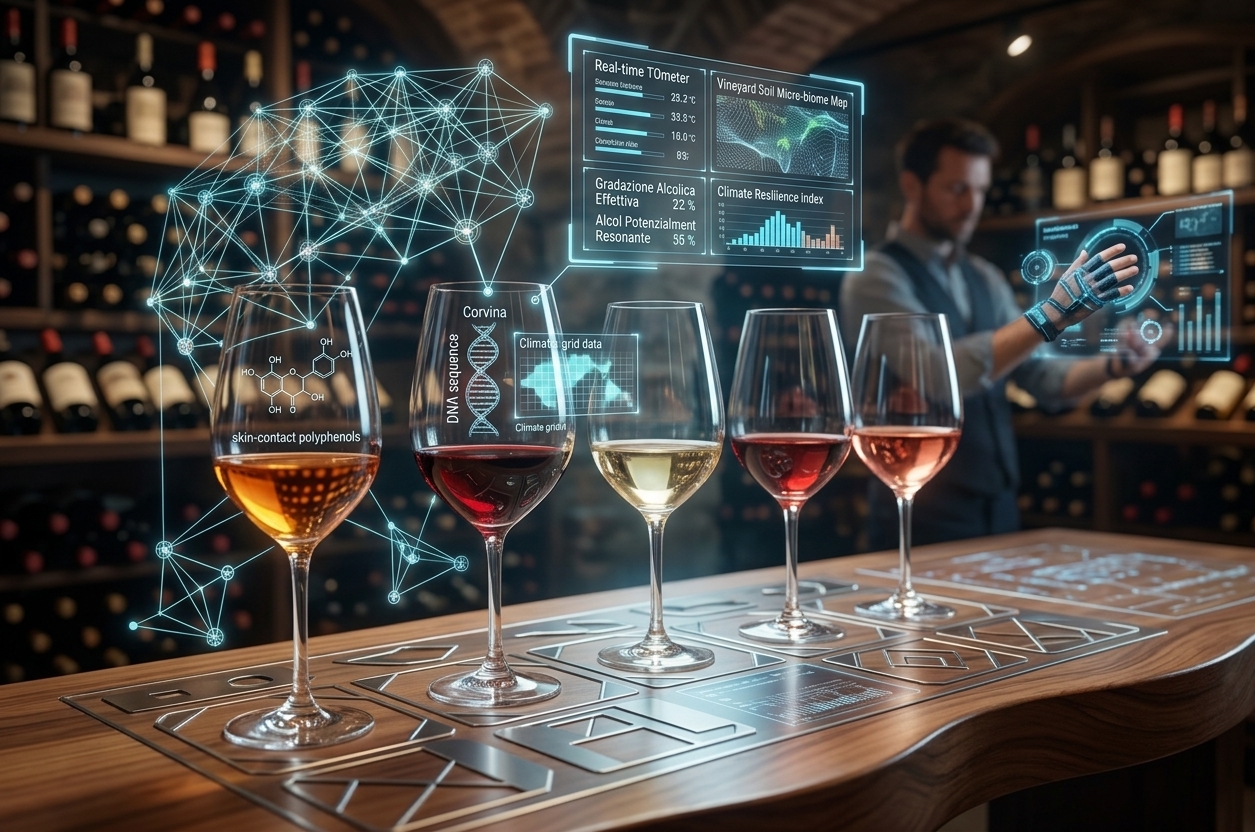
The digitalisation of the wine sector
Digitalisation can already be applied to every link of the wine supply chain, and its value comes from connecting data between vineyard, winery and market rather than from any single technology. Experience points to water savings of 8–17%, selective harvesting capable of creating distinct product lines, and traceability systems that make every bottle verifiable from a smartphone.
The picture should be read with a distinction of method. Regulatory obligations (the EU electronic label, the State seal) and the results of published trials are verified facts. Returns declared by companies and suppliers are partisan estimates. The winery digital twin and large-scale blockchain are prospects, still at an early stage today.
The main obstacle is not technological. In a 2026 study of 272 Italian growers, 58.8% reported little or no knowledge of precision technologies, and 61.4% would rather access them on a shared basis than buy them.
Overview
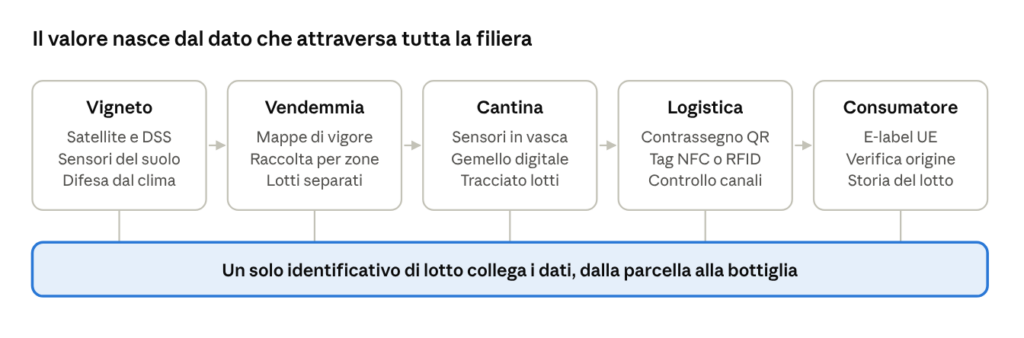
The technologies described in the following chapters deliver more when they share the same plot and batch identifier: the vigour map guides the harvest, the harvested batch enters the winery already characterised, and the bottle carries its own story all the way to the buyer’s smartphone. Each stage produces data that is useful to the next; without a shared master record they remain isolated applications, with benefits limited to a single department.
- Vineyard: agronomic planning based on satellite data
Satellite monitoring is the most accessible entry point, because it does not require buying machinery. Sentinel-2 images from the Copernicus programme are free and make it possible to calculate vigour indices such as NDVI, from which vigour maps and prescription maps for fertilisation, crop protection and harvesting are derived.
Examples available now.
• Agrosat and DigiVit (CNR-IBE). Agrosat is a free web platform that provides NDVI maps; DigiVit is an app that estimates yield from a smartphone, validated in Trentino vineyards in the 2024 and 2025 vintages. The entire vineyard area of Trentino has been loaded onto the platform.
• Vitesat project. Funded by the Tuscany Rural Development Programme and coordinated by CNR-IBE, it integrates satellite data, weather data and forecasting models into a decision support system.
• AI-GRAPE. A DSS co-funded by the Interreg Italy–Slovenia programme for timing treatments against the leafhopper Scaphoideus titanus and the grape moth, using data from weather stations, traps, satellites and drones.
Benefits. Targeted interventions where they are needed, fewer passes in the field, and an early yield estimate useful for winery planning and for managing designation volumes. It is also the technology growers are most willing to adopt: 37.1% of respondents, compared with 20.9% for drones and 9.5% for field robots.
Limits. A vigour map does not measure grape quality: the correlation has to be established by an agronomist or oenologist through ground sampling. In small or narrow vineyards, or those with grassed inter-rows, the satellite signal is less reliable (ASITA 2017) – a common situation in the fragmented plots of the Campanian Apennines. - Water: sensor-guided irrigation
Soil moisture probes, weather stations and water-balance models make it possible to decide when and how much to irrigate based on the actual state of the vineyard. The typical result is not a drastic cut in volumes, but more efficient distribution for the same yield and quality.
Available evidence.
• Franciacorta, 2020–2021. Variable-rate drip irrigation managed with two DSSs, calibrated on leaf water potential and moisture probes: 17% water saving compared with the farm standard. The source is the system supplier.
• Rutigliano (Bari), 2023–2024. A University of Bari study published in Plants, People, Planet: soil water potential sensors read every ten minutes, consumption down 14.5% in 2023 and 8.2% in 2024, with no significant differences in quality parameters. The data concern table grapes, so they can be transferred to wine grapes only with caution.
• Villa Sandi, Veneto and Friuli. Precision viticulture extended to more than 200 hectares with control units, sensors, satellites and DSS: the company estimates average water savings of about 10% and up to 20% fewer plant protection treatments. These are company estimates, not verified by third parties (Osservatorio Bilanci Sostenibilità).
• Irriframe. A free irrigation DSS developed by the Canale Emiliano Romagnolo with the Emilia-Romagna Region and extended nationwide.
Benefits. Lower water withdrawals and pumping energy costs, a more stable plant water status during stress periods, and objective records of consumption useful for sustainability certifications and funding calls.
Regulatory constraint. Many product specifications allow only emergency irrigation. In that case the sensor data also becomes documentary proof that the intervention was necessary; compatibility must be checked specification by specification. - Climate: automated protection from frost and heat
Protection against late frosts is the area where automation is most mature: temperature sensors in the vineyard switch on fans or frost-protection systems when a threshold is crossed, without anyone on duty at night. For heatwaves, digital tools today serve mainly to forecast and measure stress rather than to neutralise it.
Frost.
• Automatically starting frost fans. They mix the cold air near the ground with warmer air higher up. In the installation at the Arnaldo Caprai estate in Montefalco, supported by the Umbria Region, one unit covers 5–6 hectares, starts on its own below the set threshold and, according to the company, raised the temperature by 5–6 °C.
• Remote control. Machines with a GSM module can be managed from a smartphone; according to one manufacturer this makes them eligible for Italy’s “Industry 4.0” incentives, to be checked against current rules (FreshPlaza).
• Frost-protection irrigation. Over-canopy or under-canopy, it is the most common method in fruit growing and can be triggered by a temperature threshold.
The limits are physical: fans work in radiation frosts and down to about −4 °C, but are not very effective in advection frosts with cold wind.
Heat. Sensors, satellite maps and weather data measure water and heat stress and guide irrigation, canopy management and the harvest calendar; several Italian wineries are testing them (Italia a Tavola). Shade nets and protective treatments remain agronomic interventions that data help to plan but do not replace.
Benefits. Less production lost in extreme events, less night work, and a temperature record that can be used in insurance claims and risk management. - Harvest and winery: selective harvesting and digital twins
Selective harvesting turns variability within the vineyard from a problem into a commercial lever: grapes from different zones are separated in the field and vinified on distinct lines. In the winery, process sensors are mature; the true digital twin is still an emerging technology.
Selective harvesting.
• Two-hopper mechanical harvesting. The vigour map becomes a prescription map; the GPS-guided harvester separates grapes in real time into two bins (EnoControl system on New Holland Braud). In a two-year trial with a MECS-VINE sensor, significant differences in terpenes between vigour classes emerged in 2022 and selective harvesting made two distinct product lines possible; the effect depends on the vintage.
• Zoning by ripeness threshold. A published protocol divides each vineyard into zones A and B relative to a threshold of 23.5 °Brix, set the day before harvest on the ripening curves of each zone.
• Differentiated manual harvesting. Where mechanisation is not practical, the same map guides picking teams in separate passes by zone: this is the most realistic application for small, hillside vineyards.
• NIR spectroscopy. Non-destructive estimate of soluble solids with an R² of 0.77–0.80 in the University of Bari study, to support the choice of harvest date.
Winery.
• Fermentation control. Sensors in the tank measure temperature, density, pH and carbon dioxide and switch on cooling; the oenologist follows progress remotely (VVQ).
• Energy management and predictive maintenance. Industry scenarios point to savings of 18–25% on electricity bills and, for a medium-sized cooperative, an investment of €400,000 paid back in 19 months.
• Digital twin. A virtual replica of the winery updated with real data, used to simulate scenarios, plan operations and train staff.
Benefits. More uniform batches and range segmentation, less waste and rework, automatic recording of operations useful for documentary obligations, and operational continuity during harvest, when the workload peaks. - Market: digital labels, traceability and smartphone verification
On the market side, digitalisation is partly already a legal obligation and partly a voluntary protection tool. Three levels must be kept distinct, because they meet different needs: informing, tracing and authenticating.
Electronic label (mandatory). Since 8 December 2023, Regulation (EU) 2021/2117 has required a list of ingredients and a nutrition declaration for wines produced after that date. Ingredients and the full nutrition table may be provided via a QR code; the physical label must still show the energy value, even just with the symbol “E”, and allergens. The linked page may not contain marketing information or track the user: the regulatory e-label is therefore not, in itself, a marketing or authentication tool.
State seal with QR code (public traceability). The strip seal issued by the Italian State Printing Office (Istituto Poligrafico) is mandatory for DOCG wines and optional for DOC wines under Article 48 of Law 238/2016; the Ministerial Decree of 19 December 2023 extended it to IGT wines at the request of consortia. The reference case is in Campania: Benevento IGT was the first geographical indication to adopt it, with a first batch of 4 million seals and an obligation from 1 August 2024. The QR code links the Poligrafico database to that of the control body and gives the consumer a digital passport for the bottle. Since 15 April 2025, DOC and DOCG seals have a new tricolour design with a QR code and a platform managed by the Poligrafico at no extra cost to operators.
Single-bottle authentication (voluntary).
• NFC tags. A unique chip in the label, capsule or cork is read by holding a phone close to it. Examples: the Autentico platform adopted by ColleMassari (ESG360); OREV’s Crypto Tag, which generates a single-use link.
• Blockchain record. Firriato recorded on a blockchain the history of every bottle of Signum Aetnae 2015, including changes of ownership.
• Tracked logistics. RFID tags on cases and pallets for warehouse and distribution control, useful for detecting grey markets and channel diversion.
Size of the problem. According to the EUIPO, counterfeiting costs the European wine and spirits sector about €2.3 billion in sales a year and almost 5,700 jobs; for Italy the estimated loss is €302 million. The estimates refer to 2013–2017.
Assessment. A blockchain guarantees that recorded data are not altered, not that the data entered are true or that the physical bottle matches the record. Fighting counterfeiting depends on the physical link (seal, non-clonable tag, closure) and on upstream controls; the distributed ledger strengthens its credibility with third parties. For designations, the State seal currently offers the best balance of coverage, cost and recognition abroad, while NFC and blockchain make economic sense in the higher price bands.
Benefits. Protection of origin on foreign markets, consumer trust, feedback data on where the product is actually sold, and a documentary basis for legal action to protect the collective mark. - Artificial intelligence and AI agents
Artificial intelligence is already inside many of the technologies described in the previous chapters, as an engine for forecasting and recognition; AI agents – systems that plan and carry out multi-step tasks using software tools – are just beginning. According to one study, 31% of wine companies have invested in robotics, AI, blockchain, 5G or virtual reality, and another 55% say they are interested.
What works today.
• Forecasting models for crop protection. Algorithms that estimate the risk of downy and powdery mildew from weather and satellite data, even without sensors in the field, are offered as subscription services. However, the accuracy figures claimed by suppliers have not been verified by third parties.
• Early diagnosis. Agroscope has installed a detector in Ticino that uses AI to recognise airborne spores of Plasmopara viticola (RSI). In a vineyard near Asti, a model trained on spectral data identified diseases before visible symptoms appeared, with an F1-score above 0.8.
• Computer vision at grape intake. The system developed by Oròbix with Berlucchi and two other companies analyses images of incoming grapes and automatically flags defective lots.
• Conversational assistants. Chatbots on winery and consortium websites answer visitors in several languages and handle wine tourism requests, with WhatsApp and email integration.
• Robotics. Autonomous vehicles for mowing and spraying are being tested on farms. Robotic winter pruning, however, is still at the research stage, with the Vinum (IIT and Università Cattolica, Piacenza) and RAISE projects.
AI agents: status and potential. The most realistic short-term uses are administrative, because there the data are already digital and errors can be corrected before they have an effect.
• Compliance and documents. Pre-filling registers and declarations from winery data, updating e-labels at every batch change, checking consistency between label and product specification, export documentation.
• Funding calls and project design. Monitoring regional and EU calls, preliminary checks of requirements, drafting applications and reporting.
• Agronomic coordination. An agent that reads DSS, weather and sensor data, proposes the treatment calendar and prepares the field logbook, leaving the decision to the technician.
• Designation watch. For consortia, systematic searches of online sales channels for misuse of the protected name, flagging cases to be checked.
• Market. Sales analysis by channel and country, preparation of product sheets and translations, replies to recurring commercial enquiries.
Limits and precautions. Language models can produce wrong information in a plausible tone: for legally relevant documents, treatment doses and mandatory declarations, verification and signature remain human. The quality of the result depends on the data master record described in chapter 8, phase 1. Ownership of company data and any use of it to train third-party models must be defined by contract.
Regulatory framework. The AI Act, Regulation (EU) 2024/1689, already requires AI literacy for staff using AI systems and, from 2 August 2026, that conversational systems be recognisable as such; the obligations for high-risk systems have been postponed to 2 December 2027 and 2 August 2028 by Regulation (EU) 2026/1744. Agricultural applications mostly fall under minimal or limited risk; the exception is safety components built into machinery, which are classified as high-risk. - Summary of benefits and strength of evidence
The best-documented benefits concern water, regulatory compliance and traceability; those on wine quality and economic return in the winery still rest on estimates.
| Area | Main benefit | Who benefits | Strength of evidence |
| Satellite monitoring and DSS | Targeted interventions, yield estimate | Grower, cooperative winery | High: public tools validated in the field |
| Sensor-guided irrigation | Less water for the same yield | Grower, territory | High: published trials, one on table grapes |
| Automated frost protection | Production saved in extreme events | Grower | Medium: company data, known physical limits |
| Heat management | Forecasting and measuring stress | Grower | Low: trials under way |
| Selective harvesting | Range segmentation | Winery | Medium: results depend on the vintage |
| Winery sensors | Process control, energy savings | Winery | Medium: industry scenarios, not verified cases |
| Digital twin | Simulation and planning | Larger wineries | Low: emerging technology |
| EU e-label | Compliance, space on the label | Bottler | High: obligation in force |
| State seal with QR code | Public traceability of the bottle | Consortium, consumer | High: system operating on DOCG, DOC and IGT |
| NFC and blockchain | Authentication of each item | Premium range, export | Medium: company cases, no impact measures |
| Predictive AI and computer vision | Early diagnosis, grape selection | Grower, winery | Medium: pilot cases and supplier data |
| AI agents | Automation of compliance, funding calls, monitoring | Winery, consortium, consultant | Low: potential, no measured case |
- Limits, adoption conditions and a phased path
Adoption succeeds when it starts from simple, shared tools rather than complex company investments. The study in Precision Agriculture classifies 63.8% of growers as risk-averse and sceptical; only 18.5% are inclined to adopt almost all technologies. Growers who have taken part in rural development measures are more often among the willing adopters.
Three initial assumptions that need to be scaled back.
• Digital twins optimise quality. This is a plausible hypothesis, not a proven result.
• Blockchain fights counterfeiting. Only if combined with a non-clonable physical link to the bottle and checks on the data entered.
• Automated protection against heatwaves. Automation is real for frost; for heat, digital tools today support the decision rather than carry it out.
Cross-cutting risks. Systems that do not talk to each other and dependence on a single supplier; insufficient network coverage in inland areas; cybersecurity; ownership of agronomic data collected by third-party platforms; training needs.
A phased path.- Compliance and data master record. E-label, State seal, unique coding of plots and batches. This is the foundation that makes everything else usable.
- Low-cost monitoring. Free satellite maps, a weather station, a DSS for crop protection and irrigation. One or two seasons are needed to calibrate the models.
- Targeted automation. Sensor-based irrigation, threshold-triggered frost protection, tank sensors – only where data from the previous phase justify the investment.
- Supply-chain integration. The same batch identifier from vineyard to bottle, selective harvesting, single-item authentication for the highest-value wines.
The role of consortia and cooperatives. The 61.4% interest in shared access shows that consortium services (a single satellite platform for the area, a network of weather stations, a technical help desk, the State seal) are the most effective route for territories made up of small farms. Phases 2 and 4 lend themselves to cooperation and innovation projects under the 2023–2027 Rural Development Complements; eligibility of individual expenses must be checked call by call.
Sources (in Italian)
- Viticoltura di precisione, cosa convince davvero i viticoltori?, I Grandi Vini, 11 September 2026 (summary of the study in Precision Agriculture)
- Irrigazione di precisione: meno consumi, più efficienza, Uva da Tavola, 24 September 2026
- Etichettatura del vino: ingredienti, e-label e le regole UE per le cantine, Alimentare B2B, 7 August 2026
- Sannio Consorzio Tutela Vini estende il sistema di tracciabilità ai vini IGT Benevento, 20 Italie, 20 September 2024
- La cantina digitale: tecnologie intelligenti, controllo automatico e ritorni economici misurabili, Acta Non Verba, 8 November 2025


